13. Winslow Homer and Ten Pound Island
Trail Site #13 : Winslow Homer and Ten Pound Island
DIRECTIONS: From 2 Clarendon Street, turn left and continue down the hill on Wonson Street to the first intersection (with Stevens Lane). Ten Pound Island is visible from the street or you can walk down the public way to the water for a closer view.
Winslow Homer had a strong tie to Rocky Neck, for he lived with the keeper of the Ten Pound Island light just off its shore during the summer of 1880. By 1880, Homer had given up his direct ties to the illustrated magazines and was trying to live off his earnings from his paintings. He prepared watercolor sketches of children playing in the shallows, but his interests were deepening and he concentrated on capturing the working vessels against the background of the harbor. He mastered the relationship between water and sky, particularly the colors of sunset over the western shore of the harbor. He had spent the summer of 1873 in Gloucester, living at the hotel on the corner of Main Street and Western Avenue. In that year his main output had been pencil sketches, for he had been still tied to the magazines, as he had been since before the Civil War. That summer he began to use watercolors for the first time, and they became his medium of choice on vacation and on the road.
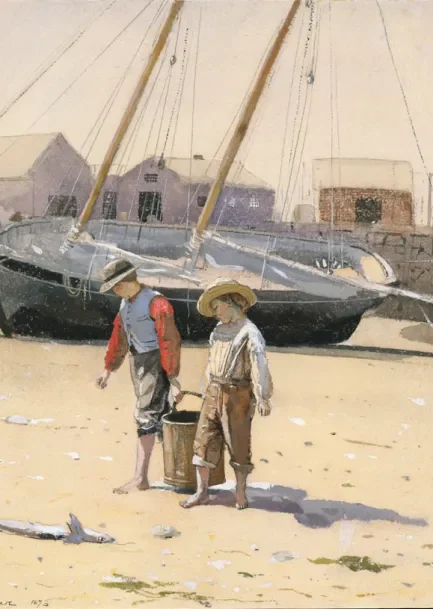
A Basket of Clams, 1873, by Winslow Homer. Watercolor, 11½ x 9¾ in. The Metropolitan Museum of Art.
His sketchbook filled with images of boys at play on the shore—boys who were preparing to become fishermen like their fathers. He was economical—the two boys in his watercolor, A Basket of Clams become (reversed) central figures in a Harper’s Weekly woodcut, Seaside Sketches —A Clambake. Back in his studio in New York, he turned some of the watercolors into oil paintings— the most famous is Breezing Up, a watercolor in 1873, a great oil painting in 1876.
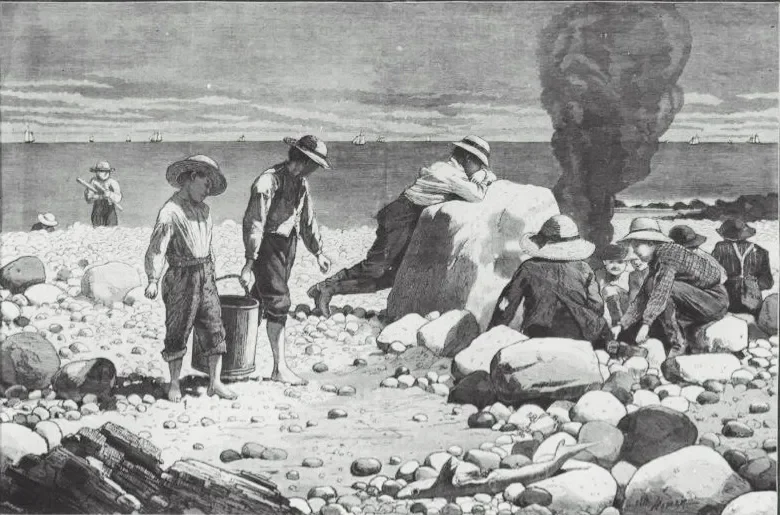
Seaside Sketches—A Clambake, wood engraving by Winslow Homer, for Harper’s Weekly, August 23, 1873, 9¼ x 14 in. Museum of Fine Arts, Boston.
Homer never painted again in Gloucester. He soon moved to Prout’s Neck in Maine, where he taught himself to paint the weight of water in oils—the greatest challenge that a marine artist faces. His time in Gloucester was short but during those two summers he worked his way through his dependence on anecdotal magazine work and began the study of the effect of the waves on the shore that was to obsess him for the rest of his life.